


TV Cast & Mirroring: All TV
Jakka Apps
TV Cast & Mirroring: All TV is a free app from Jakka Apps in the Video Players & Editors category, built around a simple idea: move videos, photos, or your phone screen onto a compatible Smart TV and use the phone as a remote. I spent time looking at it from the point of view of someone who wants to get content on a larger display without turning the process into a technical project. My overall impression is that it can be useful when the phone and television are already prepared for casting, but the quality of the experience depends heavily on the connection between those two devices.
The app is available to Everyone and supports phones running Android 8.0 or later. It is currently at version 1.1, has passed one million installs, and holds a 3.8 average from around 1.4 thousand ratings. Those figures suggest that it has found a sizeable audience, although they also hint at a mixed experience rather than universal reliability. That makes the setup details especially important: this is not the kind of tool where pressing one button can overcome every network, TV, or media compatibility problem.
Getting past the first connection
The point where many people are likely to get stuck is the first device discovery. Installing a casting app does not automatically make every television visible. The phone and the TV generally need to be connected to the same local network, and the television must be ready to receive the type of cast being attempted. If the app opens but shows no useful destination, I would check the network before assuming that the app itself is broken.
A common household complication is having several network names available. A phone may be connected to a guest network while the television is connected to the main network, or one device may have moved to a different access point. From the user's perspective, both devices appear to be online, but they are not necessarily able to discover each other. Reconnecting both to the same home network is one of the most practical first steps.
It is also worth checking the TV input and its own casting settings. A television can be switched on and still be unavailable for screen sharing if the relevant receiver function is disabled, sleeping, or waiting on another input. I would wake the TV fully, open its casting or screen-sharing area if it has one, and then return to the app. This small sequence often removes confusion caused by trying to connect to a screen that is technically powered on but not actively listening.
Related News

Instagram Is No Longer a Photo App. It Is an Attention Engine

Microsoft Teams Mobile: When Collaboration Becomes Navigation
How the NFL App Adapts to Android and iOS Updates

Temu: Elevate Your Shopping Experience to Billionaire Status

Why Traffic Rider Works Best as a Precision Reflex Game

How Google’s Find Hub Transforms Everyday Searches
The app's three main purposes should be treated separately. Casting a stored video is not exactly the same job as mirroring the entire phone screen, and displaying photos can behave differently again. If one route fails, switching randomly between options makes troubleshooting harder. I prefer to test with a single local photo first, then a short video, and only after that try full-screen mirroring. That order helps reveal whether the issue is discovery, media handling, or screen sharing.
The most useful early check is to identify which part of the chain has failed: finding the TV, starting the cast, or keeping playback stable. Each problem points to a different remedy, and treating all three as one generic connection failure wastes time.
What to check before tapping Cast
Before starting, I would keep the phone reasonably close to the router and make sure the television is not busy with another casting session. If several people in the home are using the same TV, an old session can make the device appear unavailable or cause a new request to behave unpredictably. Ending the previous session on the TV, then closing and reopening the app, is a sensible reset that does not require changing anything complicated.
Gallery
The source material matters too. A photo saved directly on the phone is a better first test than a video inside a protected streaming service or a file that is still being downloaded. Some services restrict external playback, and some files depend on codecs the TV may not handle in the same way as the phone. If a local file works while a particular online video does not, that points more toward the source or its playback restrictions than toward the casting app.
For screen mirroring, notifications and orientation deserve attention. Mirroring reproduces what is on the phone, so incoming messages, rotating screens, or an accidental swipe can appear on the television. I would enable a quiet mode when showing something to other people and lock the phone orientation if the presentation needs to stay steady. This is not a special feature of the app; it is a practical consequence of choosing full-screen mirroring instead of sending one media item.
Another useful preparation is to decide whether the phone should remain available during playback. Casting a selected video can be more convenient when you want to browse elsewhere, while mirroring is better for content that does not offer a separate castable player. If the goal is simply to show holiday photos, sending individual images or an album-style sequence is usually less distracting than mirroring every phone action.
Recovering when playback stops
When a cast begins and then stops, I would avoid immediately reinstalling the app. First, check whether the phone has changed networks, the TV has entered an energy-saving state, or the router has briefly lost its connection. A short interruption can leave the app displaying an old connection state. Stopping the current cast, waiting a moment, and starting a fresh session is often a cleaner recovery than repeatedly pressing the same control.
If the TV is visible but the picture does not appear, I would test another local item. A second photo or a different short video can show whether the problem belongs to one file. This is particularly useful when a video plays normally on the phone but fails on the TV: the two devices may support different formats even though the app can send the request successfully.
For screen mirroring, a blank or frozen result can sometimes be cleared by stopping mirroring on the TV side as well as in the app. Then I would return to the television's receiving screen and begin again. Keeping both ends of the connection in the same state matters more than rapidly repeating the phone-side command.
There is also a practical difference between a connection that fails once and one that fails every time. A one-off interruption may be caused by wireless congestion or a sleeping device. A repeatable failure with one specific file suggests compatibility or access restrictions. A repeatable failure with every local test suggests that discovery, TV support, or the home network needs attention.
I would also restart the television if it has been left in standby for a long time. Some Smart TVs do not perform a complete restart when they are turned off with the remote. A full power cycle can refresh the receiver without changing the app or deleting personal content. The same principle applies to the router, although I would reserve that step for cases where other devices are also losing connection.
When the app is not the real problem
It is easy to blame a casting app when the actual limitation is the television. “Smart TV” covers many different systems, and support for casting, screen sharing, and media formats can vary between models and software versions. The app can provide the request, but it cannot make a TV accept a connection method that the television does not support.
The network can be the hidden bottleneck as well. A weak wireless signal near the TV may allow menus and short requests to work while causing video playback to pause. Other household traffic can have the same effect. If the cast connects but buffers during busy periods, moving the router or reducing competing activity may help more than changing app settings.
Screen mirroring is especially sensitive because it continuously sends what is happening on the phone. A single video cast may be relatively steady, while mirroring a fast-moving game or a high-resolution camera view places a more demanding, ongoing load on the connection. I would choose direct video casting whenever possible and reserve mirroring for content that cannot be sent another way.
The phone itself can contribute to interruptions. Battery-saving behavior, switching between Wi-Fi and mobile data, or leaving the app while the system limits background activity may affect a session. I would keep the phone connected to Wi-Fi, avoid moving too far from the access point, and keep the app available while testing. These are basic checks, but they distinguish a stable home setup from a misleading one.
Privacy is another reason to choose the workflow carefully. A selected photo or video exposes only that item, whereas screen mirroring exposes the whole display, including accidental navigation and notifications. For a family slideshow, individual photo casting is the safer presentation style. For demonstrating an app or showing something that cannot be selected as a file, mirroring is more flexible but requires more attention.
Choosing the right everyday workflow
Imagine I have friends over and want to show a set of photos from a recent trip. I would connect the phone and TV to the same network, test one local image, and then begin sending the photos rather than mirroring the entire handset. That keeps the television focused on the pictures and lets me prepare the next item without displaying unrelated phone activity. If the first image appears correctly, I have already confirmed the most important parts of the connection.
For a saved video, I would start playback only after confirming that the TV is the intended destination. If the video is long, I would keep the phone charged and avoid wandering between network areas. Should playback fail, I would try a different local clip before concluding that the whole app is unusable. That simple comparison can reveal whether the issue is tied to the file rather than the cast route.
For a presentation or demonstration, mirroring can be the more practical choice because it shows the complete phone interface. I would prepare the screen beforehand, close private apps, silence notifications, and set the display orientation. The trade-off is that every tap and interruption becomes visible, so mirroring gives flexibility at the cost of control.
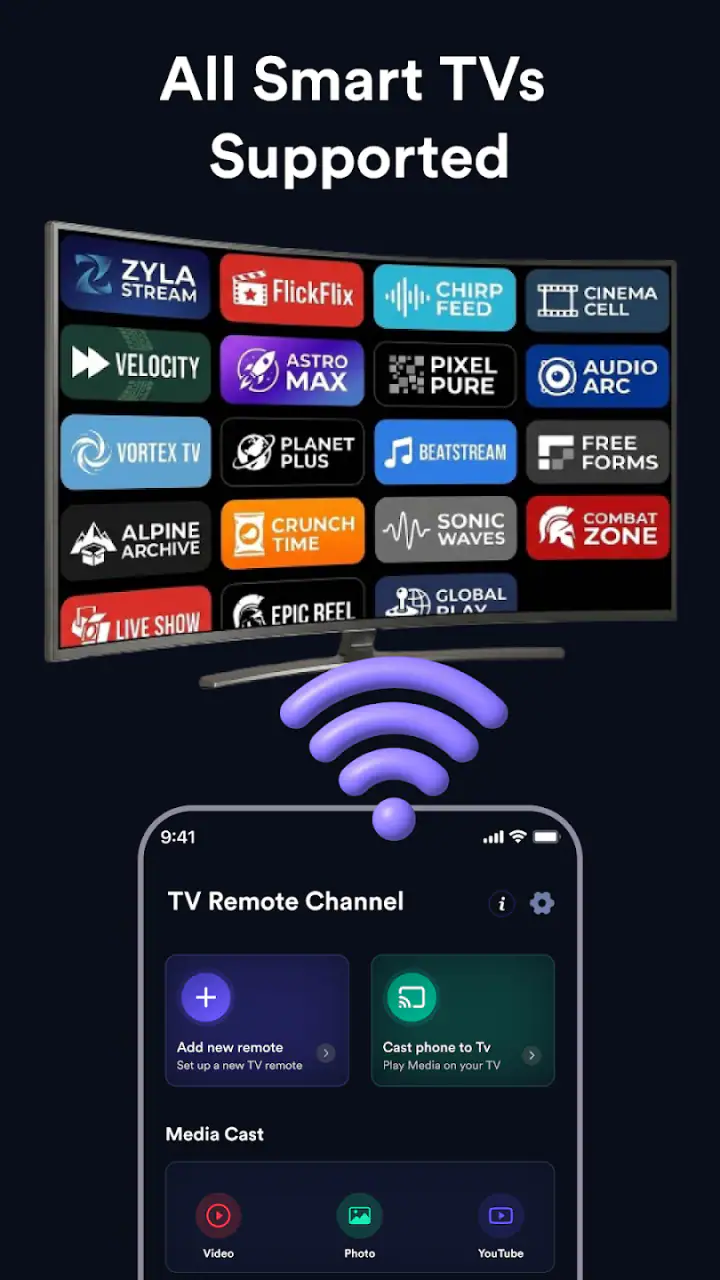
Remote control use is most helpful once the cast is already stable. I would not treat the remote function as a replacement for the television's full remote in every situation. Its value is convenience: adjusting or managing the current cast without constantly reaching for the TV handset. If discovery is unreliable, the remote experience will naturally feel unreliable too, because it depends on the same connection being maintained.
Families may appreciate the low entry cost because the app is free and aimed at a general audience. Still, free does not mean frictionless. Someone who wants a guaranteed, one-step route for protected streaming services may be happier using the official app on the TV or the platform's built-in casting button. Those alternatives often understand their own content restrictions better than a general casting tool.
How it compares with built-in options
The strongest reason to try this app is convenience across several everyday tasks in one place: photos, local videos, screen sharing, and basic TV control. It can be a useful bridge when the phone holds the content and the television is the display. The experience is less attractive if your TV already offers a dependable native casting feature and you only need to send content from one official service.
Built-in phone casting can be simpler for users who want to mirror quickly and do not need a separate interface. Official TV applications are usually better for subscription video platforms, account-based playback, and content with digital restrictions. On the other hand, a general-purpose app can feel more approachable when the goal is to display personal media rather than manage a streaming library.
I would also distinguish it from a dedicated hardware receiver. A separate receiver may offer more predictable compatibility, but it adds another device and another point of maintenance. This app keeps the setup centered on the phone and Smart TV, which is appealing for occasional use. The trade-off is that success depends more on the existing TV and network environment.
That makes the app a reasonable first experiment for people who do not want extra hardware. It is not the choice I would make for a business presentation where failure would be costly, nor for someone whose main requirement is protected streaming. In those cases, a wired connection, dedicated receiver, or official platform app may provide a more controlled path.
Who should use it and who should skip it
I can recommend TV Cast & Mirroring: All TV to people who regularly want to show personal photos, play compatible videos stored on a phone, or demonstrate a mobile screen on a larger display. It is also a sensible option for households that want to try casting before buying additional equipment. The free price removes the financial barrier to testing that setup.
I would be more cautious if your television is older, your home network is divided into isolated guest and main connections, or you need flawless playback of every video format. The app cannot remove those environmental limits. Users who dislike troubleshooting should first try the TV manufacturer's own method, especially if it is already available and working.
People concerned about accidental exposure should favor targeted media casting over full mirroring. People who need to show an entire phone workflow should accept that mirroring requires more preparation. Understanding that distinction before starting is one of the easiest ways to avoid disappointment.
The current version, 1.1, keeps expectations fairly practical: I see this as a focused utility rather than a complete replacement for every TV ecosystem. Its value comes from making common phone-to-TV tasks accessible, not from promising that every device combination will behave identically.
My practical verdict
After weighing the useful workflows against the likely setup friction, I see this as a worthwhile free tool for casual casting, especially when the phone and television already share a stable network. The ability to work with photos, videos, screen content, and remote control gives it more everyday range than a tool designed for only one type of media.
My advice is to test it methodically: connect both devices to the same network, begin with one local photo, try a short compatible video, and only then move to full mirroring. If that sequence works, the app can become a convenient part of a living-room routine. If it fails at the first discovery step, investigate the TV and network before spending time on advanced troubleshooting.
With a 3.8 average and around one million-plus installs, it is clearly not an obscure experiment, but the rating also supports a balanced expectation. Some users will find it exactly practical enough, while others will encounter limitations caused by their television, network, or source content. In my view, that makes it a good low-risk download for personal media and occasional screen sharing, but not a universal answer for demanding playback or mission-critical presentations.
FAQs for TV Cast & Mirroring: All TV
What is TV Cast & Mirroring: All TV used for?
TV Cast & Mirroring: All TV is designed to send photos, videos, music, and other compatible content from a mobile device to a television or streaming receiver. It can also mirror the phone or tablet screen on a larger display, which is useful for viewing personal media, presentations, websites, and supported apps. Its exact capabilities depend on the television, receiver, network, and device model.
Which televisions and streaming devices are compatible with the app?
Compatibility may vary, but the app is generally intended for smart TVs and supported streaming devices that allow casting or screen mirroring. Both the mobile device and the television normally need to be connected to the same Wi-Fi network. Before downloading, users should check whether their TV supports the required casting standard and review the app’s current compatibility information, since not every model or operating system is guaranteed to work.
How do I connect my phone to a TV with TV Cast & Mirroring: All TV?
After installing the application, connect the phone and television to the same wireless network, open the app, and allow it to search for available receivers. Select the desired TV or streaming device, then choose casting or mirroring when prompted. Some televisions require permission on the screen before the connection starts. If the TV does not appear, restarting both devices, checking Wi-Fi isolation, and updating the TV software may help.
Does TV Cast & Mirroring: All TV mirror every app and video?
No, screen mirroring and media casting are not guaranteed to work with every application or video service. Certain platforms use copyright protection that can produce a black screen, block playback, or limit casting to their official application. Performance also depends on the phone, TV, network speed, and video format. For the smoothest results, use locally stored media or services that officially support compatible casting technology.
Is TV Cast & Mirroring: All TV free to use, and are there any limitations?
The app may offer basic casting or mirroring features at no cost, while advanced tools, an ad-free experience, or extended functionality can depend on the current subscription or in-app purchase options. Pricing and available features may change between Android and iOS versions. Users should review the store listing before downloading and check the requested permissions, privacy information, and cancellation terms if a trial or recurring plan is offered.
Pros
- Supports casting to many popular smart TV brands.
- Simple interface makes starting a mirror session quick.
- Useful for sharing photos
- videos
- and presentations on a larger screen.
- Works well for occasional home entertainment and demonstrations.
- Offers convenient device discovery on the same Wi-Fi network.
Cons
- Requires a stable Wi-Fi connection for smooth playback.
- Some features may be restricted behind a premium subscription.
- Screen mirroring can introduce noticeable delay during fast content.
- Compatibility may vary between TV models and operating systems.
- Casting protected streaming content may not work as expected.


